

The Matthews Art Gallery presents an exhibit into the beauty, art, and skill of modern fiber artists. The exhibit will present the work of TEN Black Hills fiber artists.
This show will run from November 7-29 in the art gallery 10:00-5:00 p.m., Monday through Saturday. The opening reception will be held 5:00-7:00 p.m., Friday, Nov. 7 in the gallery. The event is free and open to the public.
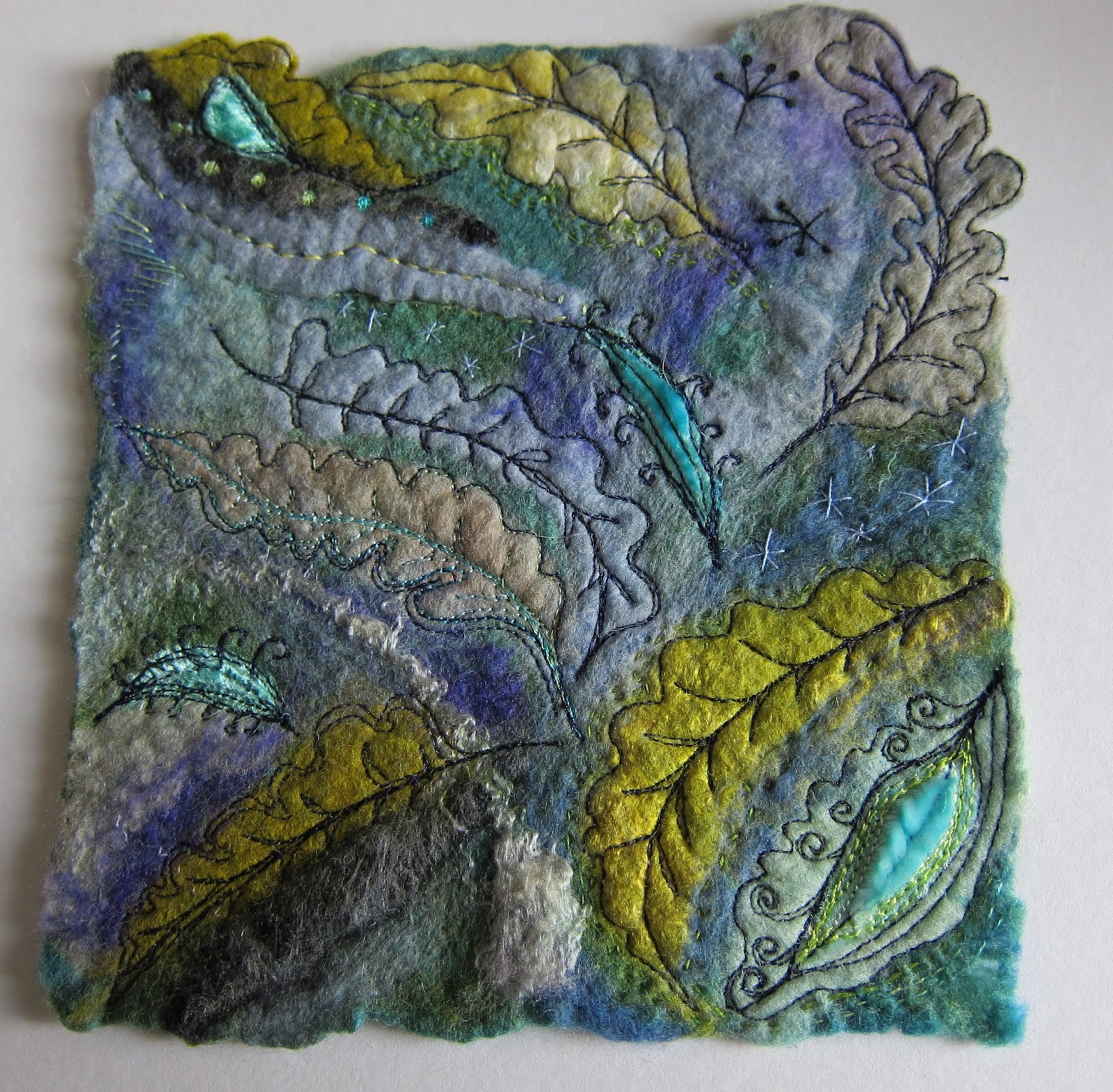
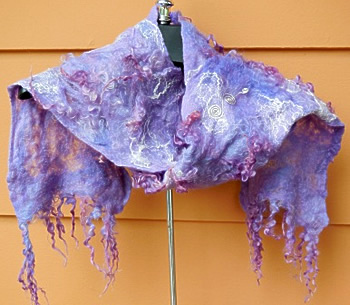 For years fiber art has been considered a craft of the homemaker. Not anymore. This Fiber Art Exhibition presents an exhibit into the beauty, art, and skill of modern fiber artists. The exhibit titled “The New World of Fiber” will present the work of 10 Black Hills fiber artists and will change your perspective on what constitutes art. From wearable artwork to exquisite tapestry, the exhibit will display a wide range of fiber art. “The caliber of artwork will surprise you and will change your view of fiber art as simply a craft, but a cultured fine art,” says gallery manager Ava Sauter.
Fiber Art. What is it?
One of the premier magazines about fiber arts, “Fiber Art Now,” explains it best.
“Art that is created using natural or synthetic fibers or techniques that are traditionally thought of as relating to fiber, such as sewing or weaving. Only one of these – fiber materials or fiber techniques – must be present for work to fall into the broad category known as “fiber art.” While contemporary fiber art is often preoccupied with materiality and technique, it’s important to also remember that the best work in fiber, like any medium, has observations, themes, or concepts at its core.
Many of the techniques and materials associated with fiber art include basketry, beadwork, braiding, clothing design, crochet, many methods of dyeing and surface design, including batik, shibori, hand-dyeing, natural or eco-dyeing; embroidery, crewel, applique, and other needle arts; encaustic; felting, including nuno felting, needle felting; hooking, including rug hooking and hooked art; knitting; knotting and knot tying; lacework; mixed media; sculpture; sewing; spinning; surface design; tapestry, textile design; wearable art; weaving, including jacquard weaving, hand weaving, saori, and many more…”
Featured Artists
We are honored and thrilled to have the following fiber artists bringing in their work for the November show. Many will be here on our opening night reception, Nov. 7. Scroll down for some artist biographies*.
- Mary LaHood – hand woven scarves and ponchos, woven baskets
- Mae Gill – Framed Handmade Fabric Scenes
- Mary McDaniel – Handmade Yarn Dolls
- Shawn Wilson – Repurposed 3D Fiber Art
- Roni Coates* – Handmade Coil Baskets
- Jean Selvy Wyss* – Tapestry
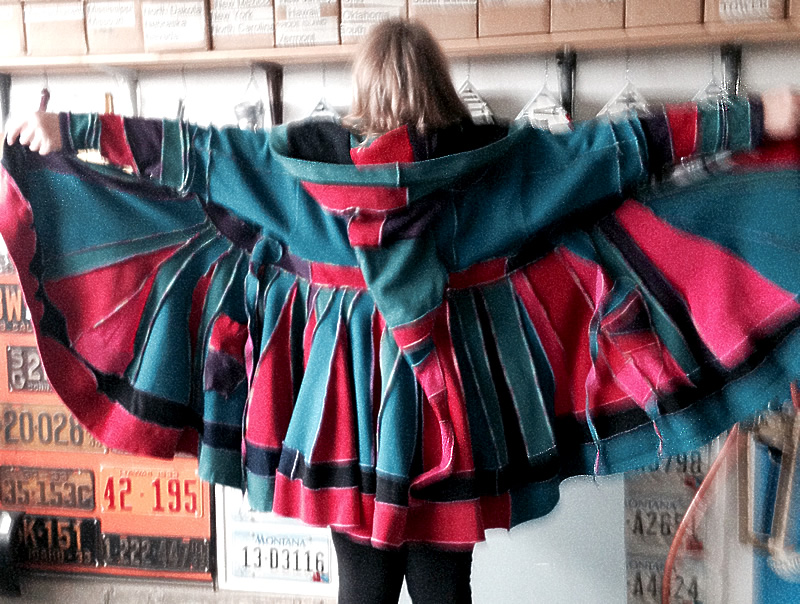
- Martha Larson* – Repurposed Katwise Style Clothing
- Ruth Beyer* – Original Coiled Baskets
- Terry Slagel* – Hand Woven Wall Hangings
- Claudia Wieland-Randall* – Yarns & Wool Felting
- Marina Astakhova – 2D Felted Artwork
- Shawn Wilson – Clothing
- Sylvia Fossum – Pine Needle baskets
Biographies
Martha Larson
I learned to sew by making clothes for my dolls with the neighbor girls. Our mothers sewed, so it was a natural thing to do on the plains in southeastern Montana.
I have quilted and learned that I was apt at creating my own designs. When I bought a serge wrap-around skirt in Portland 8 years ago, I learned how to use a serger . Since, I have improved my skills and enjoy creating Katwise inspired garments that I call, “pixy coats.” My pixy coats are made from upcycled material of %100 cotton or wool.
Ruth Beyer
Ruth Beyer and her husband live in De Smet, SD. Ruth is semi-retired as her church’s secretary, leaving plenty of time for “artist in house” and gardening. She grew up in Redfield, SD, being the oldest of three girls.
Growing up in a family with a long line of creative women, Ruth had been exposed to following her maternal grandmother through the garden, sewing, oil painting, macrame, embroidery, furniture finishing, upholstery, and designing and producing greeting cards. Her 88 year old mother now enjoys her church lady group which drew her into a weekly quilting group many years ago. They practice the dwindling art of hand quilting.
Looking back Ruth says, “I think my earliest sense of making something beautiful was when I was very young. I would sit on the floor in front of my fraternal grandmother and color pictures for her.” Her grandmother had suffered a stroke which left her partially paralyzed.
In 2003 Ruth created ReImagine ReMade. With unconventional, unexpected, and even renegade techniques and materials, she transforms items that have come to the end of their life into a second life of one-of-a-kind art pieces.
Ruth’s goal is not to be a predictable artist. Through her visualizations and unpredictability, she she shares her belief that there is no right or wrong way to make art. She aspires to have fans that comment, “I can’t wait to see what Ruth will show us next!” While she admits that she can’t know what her work will mean to others, she hopes it will provoke something, that it might be a starting place for an emotion or a thought. She would like her art to foster appreciation, even briefly, for how wonderful and complex the world that God entrusted to us is.
Roni Coates
I have enjoyed working with fabrics and yarns since grammar school and by the time I reached high school, I was skilled enough at sewing to make my own clothes. With funds being limited during the following years, making things for our home and clothes for my daughter and myself became challenging and eventually, very rewarding.
While at the University of Illinois in the 1960’s, my interest diverged and photography courses took up some of my spare time. For a long time, we even had a dark room in the basement of our house. I still love taking pictures and I firmly believe that the new digital cameras can make everyone a great photographer.
It was a chance encounter with a woman who owned a knitting machine that brought me back to yarns and knitting. We were living in San Diego then and soon I was involved with a large and active group of machine knitters. Then, after years of making sweaters and baby clothes, I began looking for a new interest. I was seriously considering quilting and it was during a trip to a quilting store, that I noticed a flyer announcing a class on making fabric baskets. The idea intrigued me, plus I had years of leftover fabrics!
Although I enjoyed a decades-long academic career, it is working with my hands that still brings me the greatest pleasure and satisfaction at the end of the day.
Jean Selvy-Wyss
I love texture. I love color. I am a fiber artist. I am a gatherer.
I am trained as a tapestry artist. I love to weave. The texture and color, the building up, the techniques themselves are wonderful and challenging, the pixel-like format. But because of the nature of the beast, it is a time consuming art form. Because of that, I like to “play” with other elements. These elements are usually fiber/texture based but I also love to collect old, discarded, and forgotten elements that come to me because of their potential for a new ‘life’. The ‘problem-solving’ element that happens in the creation of these pieces is an exciting part of it. Telling their story comes as I work on each piece.
I like the word ‘potential’. It means to me ‘a new view’, ‘ a path changer ‘, a wandering direction’. I work in series, creating in tapestry as well as the mixed media collage. Several of these series are about women and their paths. The ‘South Dakota Cowgirl’ series is about women’s tenacity and strength. The ‘Angels’ series is about belief in your dreams and faith in the future, discovering your own spiritual path. At the moment, I am working on a series of ‘wings’. In all my connections with women, the thread I pick up from them and myself is that we are looking for our wings, to find our own potential, to fly. And we better be laughing along the way.
Terry Slagel
Weaving is the magical process of turning ordinary threads into functional and artistic textiles. Finished pieces exemplify the fact that the uniquely beautiful can be created from simple beginnings.
Terry weaves textiles that combine old world Scandinavian techniques with both traditional and contemporary color combinations and fiber selections. The fabrics are entirely hand woven on a manual loom and some are then hand sewn to a variety of fleece resulting in stunning display pieces designed to inspire conversation and provide years of pleasure for the senses. Pieces project an air of western, native, alpine and rustic lodge.
Traditionally, the woven fleece-mounted blanket was of home crafted yarns mounted on field sheep pelts. Terry takes the customary weave structures, patterns and fibers to new artistic levels, mixing a wide variety of yarns with exotic fleece results in three dimensional works bursting with color and texture.
The array of hand-spun and commercially prepared fibers include not only sheep but bison, alpaca, llama, linen and cotton. These additions provide a richer palette of color, texture, and culture. Her one of a kind textiles are made of only the finest materials including the breath-taking sheep and goat fleeces from around the globe.
Terry honed her skills on Swedish style looms over the past 25 years, while living in Colorado and now South Dakota. In addition to self-directed study, she attended numerous classes and seminars throughout the US. Most recently, she completed a seven month apprenticeship at Vävstuga, a Swedish weaving school in western Massachusetts, in December 2012.
Through her work, Terry hopes to display an alternative artistic medium that allows others to share the comforting beauty of these tactile creations and inspires them to keep the time-honored patterns and techniques of textile designs alive for centuries to come.
Claudia Wieland-Randall
I love the idea that animal fiber is a renewable resource and that the animal does not have to die to have its fiber harvested. This fact and the inspiration I receive from traditional designs are reflected in my business name, “Once Again.“
I explored fiber first, as a teenager, through sewing garments, and now, through felting, spinning, knitting and weaving. I love that the process has not changed much in thousands of years. It is still an important part of the daily lives of men and women throughout the world–from the Himalayas to the Andes, from Paris fashion runways to South Dakota.
Felting dates to cave-age people who placed animal fiber in their foot coverings. The action of walking and rubbing the fiber processed it into felt. A lot of rubbing still happens to create felt. For my felted items I use high quality, fine, soft Merino or Blue Faced Leicester (sheep) and embellish it with other wools and silk. The silk gives an item a ruche effect, adding another texture.
U.S. / South Dakota sourced fibers are used throughout my work, including natural or commercial dyes.